

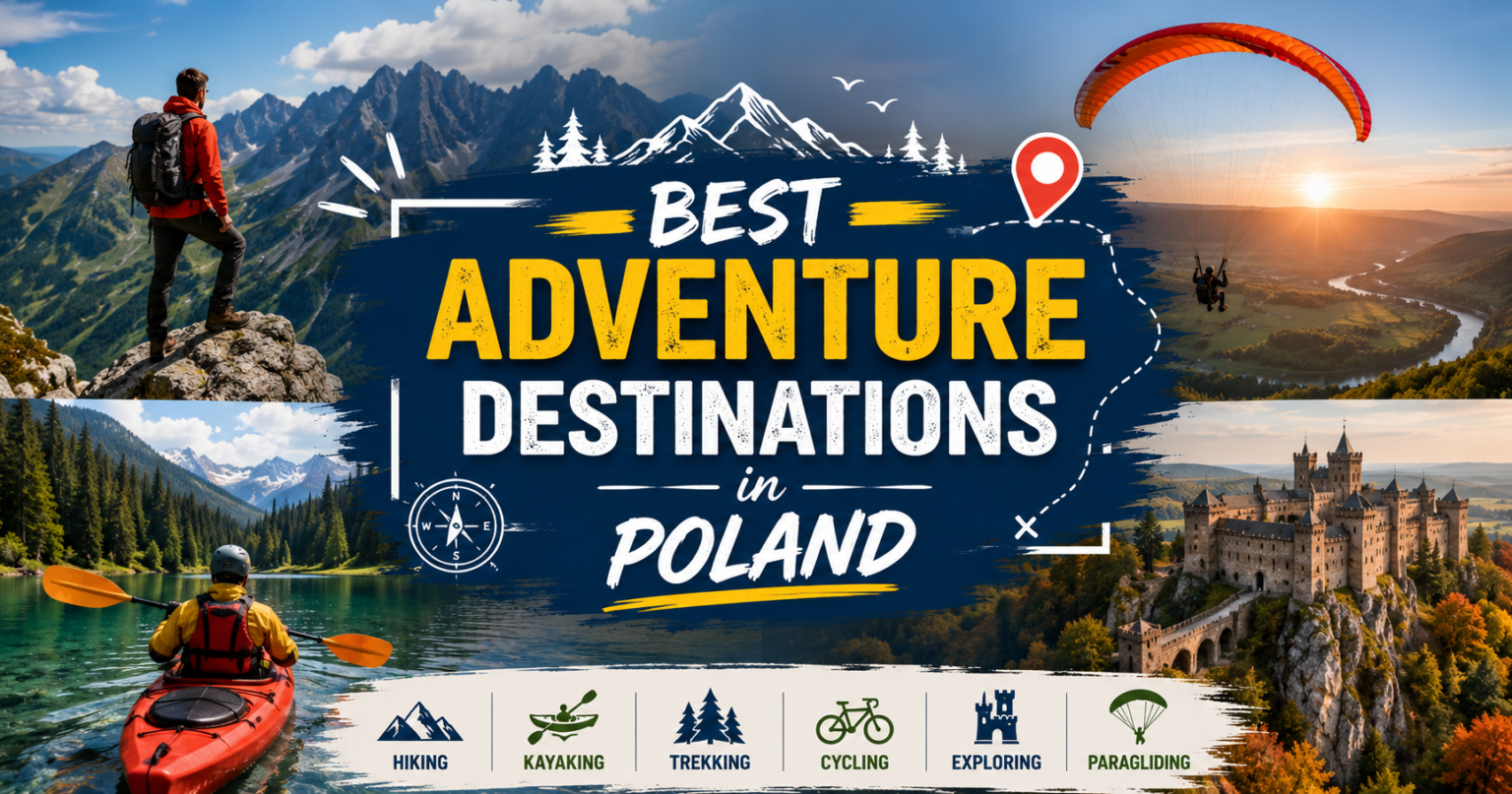

Poland does not always make the first shortlist when travelers plan adventure trips in Europe. That is a mistake most people only realize after they arrive.
From the jagged peaks of the Tatra Mountains to the ancient silence of Białowieża Forest, Poland offers outdoor experiences that rival far more promoted destinations — often with fewer crowds and lower costs. If you are searching for the best adventure destinations in Poland, this guide covers the places that actually deliver, with real terrain, real activities, and conditions that hold up beyond the brochure.
Whether you want to ski FIS-rated alpine slopes, kayak through 4,000-lake wetlands, or descend into caves used by medieval kings, Poland has the geography to back it up. Before you pack for the Dolomites or Fjords, read through what this country puts on the table. For broader inspiration, also check out the Best Adventure Destinations in the World to see how Poland compares globally.
1. Tatra Mountains – Hiking and Skiing Paradise
The Tatras are the highest mountain range in the Carpathians and the only truly alpine terrain in Poland. Most travelers underestimate how serious this terrain gets.
Kasprowy Wierch, rising to 1,987 meters, is the central peak for both winter and summer activity. It holds Poland’s only alpine ski resort with FIS-rated slopes across the Gąsienicowa and Goryczkowa basins. The mountain runs on natural snow — no artificial snowmaking — because the area sits inside a protected national park.
Key activities:
- Skiing and snowboarding on FIS-rated natural snow slopes (winter)
- Hiking to Świnica, Giewont, and Hala Gąsienicowa (summer)
- Cable car ascent from Kuźnice — the original cableway was built in 1938, making it one of Europe’s oldest
- Morskie Oko lake hike — one of the most visited trails in the country, and for good reason
The hike from Kuźnice to the summit takes 2–3 hours depending on your trail choice. The green route is gradual; the black trail is steep. Hikers who skip Giewont usually regret it — the summit cross at 1,894 meters is iconic, and the panoramic views stretch across the Tatras on clear days.
Best time to visit: December through March for skiing; June through September for hiking.
2. Bieszczady Mountains – Wild and Remote Trekking
Most mountain regions in Poland have signposted trails, mountain huts, and weekend crowds. Bieszczady is different.
Located in the far southeastern corner of Poland near the Ukrainian and Slovak borders, Bieszczady is one of the least developed mountain regions in Central Europe. The landscape is defined by rolling, treeless ridges called połoniny — sub-alpine meadows that offer unobstructed views for miles in every direction.
What makes it different from the Tatras:
- Far lower visitor numbers even in peak season
- Multi-day trekking without the infrastructure pressure
- Wildlife including brown bears, wolves, lynx, and European bison
- The Bieszczady Loop road covers over 150 km through villages, forests, and highland terrain
Trekking the main ridgeline from Tarnica (1,346 m) to Halicz takes a full day and requires no technical climbing — but the remoteness means you need to plan water, shelter, and navigation in advance. This is not a destination where you improvise.
If you want mountain adventure without tourist infrastructure deciding your itinerary, Bieszczady is one of the best adventure destinations in Poland for serious trekkers.
3. Białowieża Forest – Nature and Wildlife Adventure
Białowieża looks like a simple forest trip until you understand what you are actually standing inside.
This is the last remaining fragment of Europe’s primeval lowland forest — the kind of forest that once stretched across the entire continent before human settlement cleared it. The Polish-Belarusian territory covers over 140,000 hectares and has held UNESCO World Heritage status since 1979. You cannot replicate this environment anywhere else in Europe.
What to know before you go:
- The most ecologically intact section — Białowieski National Park — requires a licensed guide to enter
- The forest is home to the European bison, the continent’s heaviest land animal, successfully reintroduced into the wild in 1952
- Wildlife tracking includes bison, lynx, wolves, and over 250 bird species
- The village of Białowieża sits approximately 260 km from Warsaw, reachable by bus via Białystok
For travelers who want active exploration, guided wildlife walks and cycling routes through the outer forest zones are available without a permit. The core national park sections require an authorized guide — book in advance, especially in summer.
Białowieża is not a high-adrenaline destination. It is the kind of place where the scale of what you are experiencing hits you slowly. That is what makes it worth the trip.
If you are comparing adventure options globally, the Best Adventure Destinations in the World list gives useful context for how Białowieża fits against other UNESCO wilderness destinations.
4. Mazury Lake District – Kayaking and Water Sports
Masuria has over 4,000 lakes. The region covers 52,000 km² in northeastern Poland and connects most of those lakes through rivers and canals, creating one of the most extensive paddling networks in Europe.
The largest lake, Śniardwy, covers 114 km². The deepest, Czarna Hańcza, drops to 108 meters. Between them and thousands of connected waterways, this is where you go when you want water-based adventure without an ocean.
What to do in Masuria:
- Kayak the Krutynia River — Poland’s most famous paddling route, measuring approximately 100 km through quiet forest and wildlife reserves
- Sailing — the interconnected lake system makes Masuria one of Central Europe’s top sailing destinations
- Cycling through forest trails and lakeside routes
- Wildlife watching — the Luknajno Reserve hosts around 1,000 mute swan breeding pairs annually and holds UNESCO Biosphere Reserve status
The Krutynia route is the benchmark experience. It runs through the Masurian Landscape Park and can be broken into multi-day segments with camping stops. Current rental infrastructure along the route is well developed, which makes it accessible for intermediate paddlers — but do not expect luxury facilities.
Best time to visit: Late May through September for paddling; July and August for sailing.
5. Dunajec River Gorge – Rafting and Scenic Beauty
Dunajec Gorge sounds like a casual boat ride until you see the terrain it cuts through.
The gorge runs along the border between Poland and Slovakia, carving through the Pieniny Mountains over roughly 8 kilometers of dramatic limestone cliffs. The raft trip — conducted on traditional wooden rafts steered by highland boatmen in regional dress — covers about 18 km and takes approximately 2 hours on the water.
What to expect:
- Limestone cliff faces rising up to 300 meters above the river
- River passage along the Polish-Slovak border, with landscape visible on both sides
- Departures from Sromowce Kąty and Szczawnica (the endpoint with shuttle transport back)
- No prior experience required — the rafts are guided, not self-operated
The gorge is manageable for most fitness levels, which makes it a good option when traveling with mixed-ability groups. If you want more technical water adventure, the surrounding Pieniny region also offers hiking trails with views directly above the gorge.
Pair this trip with Zakopane — the two destinations are within a 90-minute drive and complement each other well.
6. Karkonosze Mountains – Year-Round Outdoor Activities
The Karkonosze Mountains in southwestern Poland sit on the border with the Czech Republic and offer the kind of year-round outdoor infrastructure that the more remote regions lack.
Śnieżka, the highest peak in the Karkonosze range at 1,603 meters, is accessible by foot or by a combination of chairlift and trail. The Czech side of the mountain has its own infrastructure, and cross-border hiking is common.
Activities by season:
- Winter: Downhill skiing and snowboarding at Karpacz, cross-country trails through the Giant Mountains National Park
- Summer: Hiking through subalpine moorland, cycling routes along the Czech border, mountain biking
- Year-round: The Śnieżne Kotły glacial cirques — two dramatic valleys carved by glaciers — are accessible in most conditions
What makes Karkonosze practical:
- Shorter drive from Wrocław and Berlin than the Tatras
- Established resort infrastructure in Karpacz and Szklarska Poręba
- Cross-border trail access adds variety without requiring a separate trip
For budget travelers, this region tends to come in below Zakopane pricing on accommodation. If Cheapest Countries to Visit is a framework you use for trip planning, western Poland generally benchmarks cheaper than equivalent destinations in Austria or Switzerland for the same mountain activity.
7. Zakopane – The Adventure Capital of Poland
Every adventure destination in Poland eventually connects back to Zakopane.
Positioned at the foot of the Tatra Mountains, Zakopane is Poland’s primary mountain resort town and the launch point for most Tatra adventures. It is not a hidden gem — the town draws millions of visitors annually — but the infrastructure it offers is what makes multi-day Tatra exploration practical.
What Zakopane provides:
- Cable car access to Kasprowy Wierch (15-minute ascent, built 1938, fully modernized)
- Gubałówka funicular for panoramic views over the town and mountains
- Gear rental, guided tour operators, and trail head access within walking distance
- Krupówki Street — the main pedestrian promenade — for food, supplies, and local culture
Ski conditions: Zakopane’s ski area at Kasprowy Wierch runs on natural alpine snow. This means season length depends on actual snowfall, not artificial production. Typically reliable from December through March.
Where Zakopane fits your planning: Use it as a base, not just a destination. If you are doing multi-day Tatra hiking, the town’s trail access and accommodation density are what make it worth building your itinerary around.
For those thinking beyond Poland, the How to Travel the World on a Budget guide includes practical frameworks for planning multi-destination adventure trips without overspending on logistics.
8. Ojców National Park – Caves and Nature Walks
Ojców is the smallest national park in Poland at just 21.46 km². That statistic makes most travelers expect something underwhelming. They are wrong.
Located less than 45 minutes from Kraków, Ojców packs limestone rock formations, medieval castles, caves with 120,000-year-old human traces, and 17 bat species into a compact valley system that you can meaningfully explore in one or two days.
What to do in Ojców:
- Łokietek Cave and Ciemna Cave — both open with guided access; Ciemna Cave contains archaeological evidence of human presence dating back 120,000 years
- Rock formations including Maczuga Herkulesa (Hercules’ Club), a 25-meter freestanding limestone formation, and Brama Krakowska (Krakowska Gate)
- Pieskowa Skała Castle — a Renaissance-era castle built in the 14th century as part of the Eagle’s Nests defense line
- Ojców Castle ruins — defensive walls and a residential tower from the same defense network
Trail options:
- A 10 km loop trail starting from the Złota Góra parking area covers the main valley, rock formations, cave access, and castle views in 4–5 hours
- Shorter routes through Sąspowska Valley take 1–2 hours and suit families or lower-mobility visitors
Practical tip: The park is best explored by bike or on foot. Cars must be parked at designated areas on the park’s perimeter. Book guided cave tours in advance during summer — capacity is limited.
If you are traveling through southern Poland and need efficient planning resources, the Complete Dhigurah Island Travel Guide and our How to Explore Ciletuh Geopark guide demonstrate the kind of destination-specific logistics planning worth applying to a Kraków-Ojców itinerary.
Why Poland Deserves More Credit for Adventure Travel
Most travelers still associate Poland primarily with Kraków’s Old Town or Warsaw’s wartime history. That framing misses half the country.
The best adventure destinations in Poland stretch across every region — alpine terrain in the south, ancient forests in the east, glacial lake systems in the north, and limestone gorges connecting them. The country has the geography, the national park infrastructure, and the trail access to support serious adventure travel across all seasons.
What Poland lacks is the marketing profile of the Alps or Scandinavia. That gap is exactly why experienced adventure travelers are choosing it.
Costs run lower than equivalent destinations in Austria, France, or Norway. Crowds are manageable outside the Tatra high season. And the variety of terrain — from FIS-rated ski slopes to primeval forest wildlife tracking to 100 km kayak routes — means a single trip can cover genuinely different experiences without covering enormous distances.
If you are building an adventure travel shortlist for 2026, Poland belongs on it.
For broader context on building high-value, low-cost adventure itineraries, see our guides on the Best Places to Visit in India, Top 5 Most Expensive Palaces in India for cultural contrast, and Best Luxury Resorts in the Maldives if you want to balance an active trip with high-end recovery.
Poland rewards travelers who look past the surface. Start with one of these destinations. You will understand why within a day of arrival.